Cognism CRM Enrichment
Enhancing prospecting journey
This feature aims to optimize CRM quality through data health analysis and automated enrichment workflows to improve data accuracy, customer profiles, and marketing effectiveness.
Client
Cognism
Services
Product Design
Industry
B2B SaaS
Date
2025 - 2026

Cognism helps revenue teams identify, understand, and connect with the right prospects faster. For this CRM Enrichment experience, the focus was on turning fragmented customer data into clearer profiles, healthier records, and more confident sales and marketing decisions.


Rapid prototyping & Internal testing
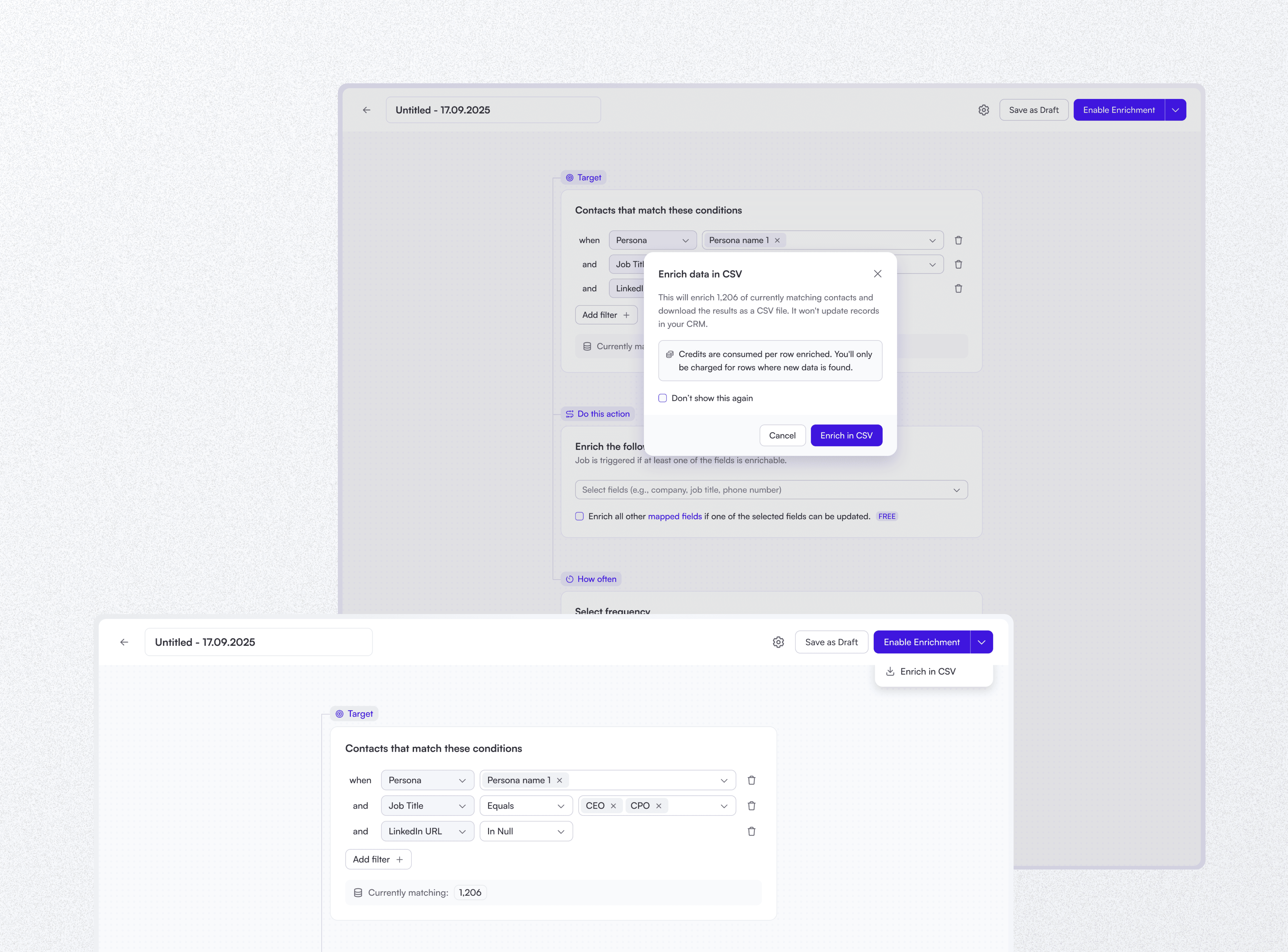
While the engineering team was refactoring the backend and laying the technical foundations for the new CRM Enrichment architecture, I used that time to explore ideas rapidly. Using v0 and Claude, I created a range of interactive prototypes to test different approaches before any frontend development began. We ended up with three main parts of new experience that we needed to focus on the most - Data Health Dashboard, Enrichment Creator supporting Contacts, Accounts and Leads, and Results page. Instead of validating polished designs, we focused on validating concepts. Through quick usability sessions with internal teams and selected customers, we gathered feedback early, refined workflows, and eliminated weaker ideas before they reached development. By the time the frontend implementation started, the team had confidence that the core experience had already been tested, reducing uncertainty, rework, and costly design changes later in the process.


Alpha & Beta Testing
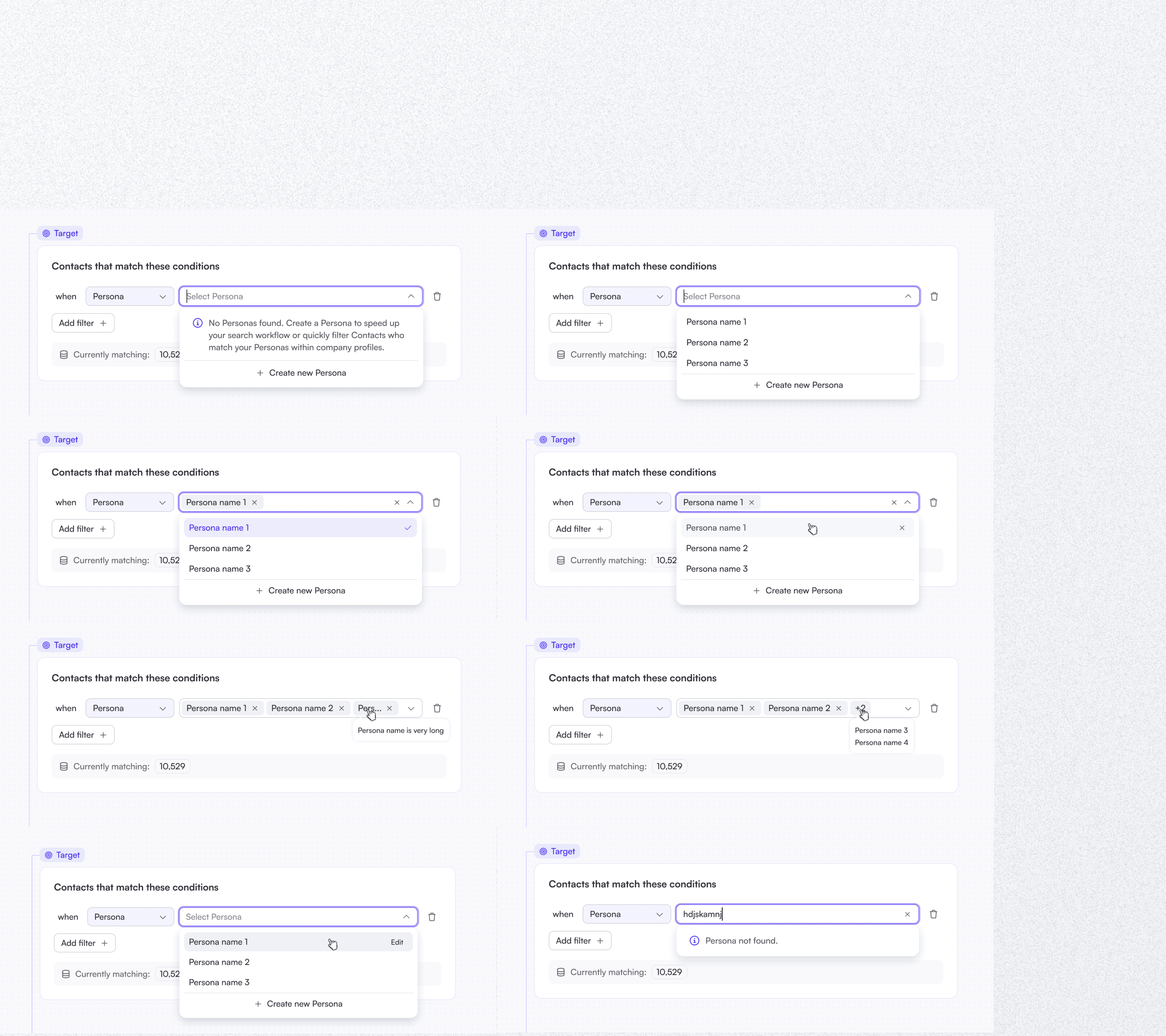
Before launch, I planned and facilitated an end-to-end alpha & beta testing programme to validate the CRM Enrichment experience on our end users. Primary objective? To evaluate the flexibility of Enrichment Studio in supporting complex, customized workflows and find out whether the Dashboard effectively communicated data health insights, enabling users to identify issues and take appropriate action. The research combined moderated semi-structured usability testing with a three-week diary study. I prepared realistic Salesforce test environments, task-based scenarios, observation frameworks, and questionnaires to evaluate the entire enrichment journey. The testing sessions uncovered several implementation bugs, and edge cases that needed to be addressed before launch so we can confidently say our solution is a strong MVP. It also gave us a clear direction for future iterations by revealing feature expectations, like adding AND OR logic and combining Cognism filters (e. g. Persona selection) with CRM fields. Implementing these early improved product quality and reduced the risk of end customer-facing issues after the release.

Defining new standards
As a Product Designer, my role extended beyond feature design. I helped establish the foundations for how the new Cognism platform was designed and built. This included defining reusable interaction patterns, UX writing principles, and robust user flows that considered error states and edge cases from the outset. I also introduced improvements to the design process, from more collaborative discovery practices and retrospectives to a clearer design-to-development handoff. I partnered with the team to define the Mixpanel tracking strategy, identifying the events, properties, and funnels needed to measure adoption and user behaviour. To ensure consistency across teams, I created a Metrics cheatsheet, outlining the metrics product designers should consider when designing new features. Together, these initiatives improved consistency, strengthened collaboration between design and engineering, and created a scalable foundation that enabled the product to evolve with greater speed and quality.

Final Impact
The redesigned experience achieved 92% adoption among migrating users, demonstrating strong confidence in the new platform over the legacy Prospector solution. By making Enrichment easier to discover and reducing the Time to Value to under 30 seconds - around 3× faster than before - customers could start improving their CRM data almost immediately. Despite introducing significantly more powerful capabilities, including automation and complex enrichment criteria, the average time to configure an enrichment fell from 7 minutes to 4 minutes 50 seconds (31% faster). This reduced manual effort while enabling more sophisticated workflows. Beyond usability, CRM Enrichment became a key business driver. Feedback from 500+ Account Managers showed that the feature significantly increased the value of the Cognism platform and directly supported the company's objective of improving customer data quality. It also became a strong differentiator during sales conversations, with 85% of sales representatives reporting that it helped close new deals. Combined with plan upgrades and increased product usage, CRM Enrichment contributed approximately £9M in annual revenue, reaching approximately one-third of the company's total revenue. *The product is still evolving as customers continue migrating from Prospector to Cognism, so these results represent the current stage of an ongoing transition.
Great products are built on strong foundations. Understanding technical constraints, validating ideas early, balancing user needs with engineering realities, defining how success would be measured, and establishing scalable design patterns proved just as important as designing the interface itself.
What would I do differently?
Avoid designing too far ahead of development: As engineering focused on rebuilding the backend foundations, design naturally progressed faster. By the time some features reached implementation, requirements had evolved. Working in smaller, iterative increments would have reduced rework and kept designs aligned with the latest product direction. Introduce a design changelog from day one: Frequent team changes meant valuable context was often lost when people moved on. A shared changelog documenting key decisions, trade-offs, and rationale would have preserved knowledge, made it easier for new team members to understand past decisions, and reduced repeated meetings around the same design choices.